
Would you like to switch to the accessible version of this site?

Go to accessible site Close modal window

Don't need the accessible version of this site?

Hide the accessibility button Close modal window
Accessibility View Close toolbar
Eye Catchers

204 E. College Blvd.

Roswell, NM 88201 USA

575-625-9800

Open mobile navigation
  • Home
  • New Patient Center
    • Online Forms
    • Payments Options
  • Eyecare Services
    • Contact Lens Exams
    • Eye & Vision Exams
    • Lasik Eye Surgery
    • Eye Surgery
    • Hard to Fit Contacts
    • Computer Vision
    • Sunglasses
  • Frame Selection
  • About Us
    • Meet The Optometrist
  • Contact Us
  • Blog
  • Community Content
    • Common Eye Conditions
      • Age-Related
      • Cognitive and Acquired
      • Vision Impairment
      • Injury & Irritation
      • Eye Lids
      • Changes in Appearance
    • Contact Lenses
    • Eye Diseases
    • Eyeglasses
      • Eyeglass Lenses
    • Eye Symptoms
    • How the Eyes Work
      • Basic Visual Skills
    • Pediatric Vision
    • Protecting Your Eyes
    • Visual Rehabilitation
    • Vision Problems
    • What is Vision Therapy
    • Vision Therapy Programs
    • We Can Help With
      • Cataracts
      • Corneal Disorders
        • Disorders
      • Glaucoma
      • Refractive Disorders
      • Adult Strabismus
      • Retinal Disorders
    • Newsletters
      • Glasses & Frames
      • Contacts
      • Tips for Healthy Eyes
      • Conditions That Affect Vision
      • Kid's Vision
      • Amazing, Interesting Eyes
      • Medical Perspectives
  • Home >
  • Articles >
  • Common Eye Conditions >
  • Vision Impairment >
  • Color Blindness

Color Blindness

  • Created in Common Eye Conditions, Vision Impairment

color blindness

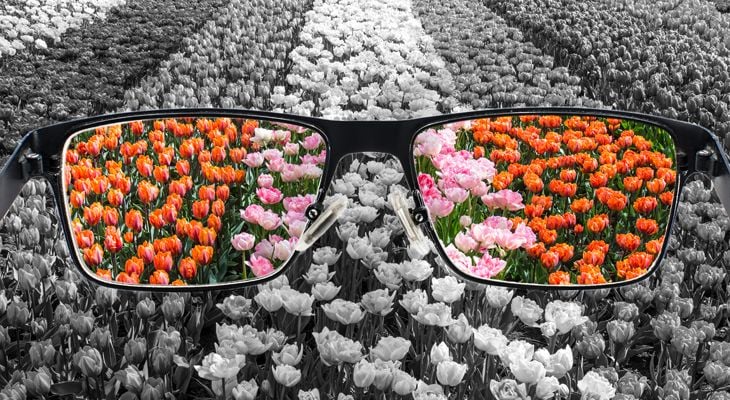
Color blindness, also known as color vision deficiency, occurs when an individual cannot distinguish between certain colors like red and green or, less commonly, blue and yellow.

Cause of Color Blindness

Light-sensitive tissue, the retina, lines the back of the eye and consists of two types of light distinguishing cells: rods and cones. While rods detect or see light and dark, cones are responsible for detecting color and sending the information to the brain for processing. Your eye has three types of cones; one for perceiving red, another for blue, and third for green. In a healthy eye, the cones work together to facilitate your ability to see a broad range of colors. When one or more type of cone functions abnormally, color deficiency occurs.

Color Blindness Symptoms

Depending on which cones are affected, the symptoms of color blindness range from mild to severe. Mild color blindness is defined as difficulty distinguishing colors in low light, and severe color blindness can leave someone seeing only a range of grey tones. Symptoms of color blindness include having difficulty seeing colors or their brightness, and the inability to distinguish between different colors. People with color blindness most frequently have a hard time telling the difference between red and green or blue and yellow.

Risk Factors for Color Blindness

Most individuals with color deficiency are born with it. Congenital color blindness is usually inherited as a genetic trait passed down from mother to son. Males are much more likely than females to inherit color deficiency, experiencing color blindness from birth.

Color blindness, however, can develop as the result of disease, medical conditions, trauma, or as a side effect of medication. Conditions that may lead to color blindness include macular degeneration, glaucoma, Parkinson's disease, Alzheimer's disease, leukemia, sickle cell anemia, and alcoholism. Color blindness which develops later in life as the result of a condition is known as acquired color deficiency.

Diagnosis and Treatment

An eye care professional diagnoses color blindness with a simple test. The patient is shown diagrams comprised of differently colored dots. Color blind individuals will not be able to distinguish shapes or numbers hidden among the dots in a different color.

While there is no cure for congenital color blindness, special lenses for glasses or contacts have been developed to help color deficient individuals distinguish between colors. Acquired color blindness can sometimes be treated by addressing the underlying cause.

  • Common Eye Conditions
    • Age-Related
    • Cognitive and Acquired
    • Vision Impairment
    • Injury & Irritation
    • Eye Lids
    • Changes in Appearance
  • Contact Lenses
  • Eye Diseases
  • Eyeglasses
    • Eyeglass Lenses
  • Eye Symptoms
  • How the Eyes Work
    • Basic Visual Skills
  • Pediatric Vision
  • Protecting Your Eyes
  • Visual Rehabilitation
  • Vision Problems
  • What is Vision Therapy
  • Vision Therapy Programs
  • We Can Help With
    • Cataracts
    • Corneal Disorders
      • Disorders
    • Glaucoma
    • Refractive Disorders
    • Adult Strabismus
    • Retinal Disorders
  • Newsletters
    • Glasses & Frames
    • Contacts
    • Tips for Healthy Eyes
    • Conditions That Affect Vision
    • Kid's Vision
    • Amazing, Interesting Eyes
    • Medical Perspectives

Contact Us

Featured Links

Click to find out more

Monday:

Closed

Tuesday:

8:30 am-12:00 pm

1:30 pm-5:00 pm

Wednesday:

8:30 am-12:00 pm

1:30 pm-5:00 pm

Thursday:

8:30 am-12:00 pm

1:30 pm-5:00 pm

Friday:

8:30 am-12:00 pm

1:30 pm-5:00 pm

Saturday:

8:30 am-12:00 pm

Sunday:

Closed

Testimonials

Reviews From Our Satisfied Patients

  • "We use Anderson Optometry for all of our family’s vision needs. Recently, we had to have our youngest fitted for new glasses and he made the experience fun for her and informative for us. We know Dr. Anderson will always take good care of our family’s eye care and that’s why we wouldn’t go to anywhere else."
    The Harrison Family
  • "Dr. Anderson and his staff are so patient and friendly. Dr. Anderson prescribed me glasses and I had the toughest time picking out frames. They didn’t rush, but instead made helpful suggestions and now I have an awesome pair of frames, not to mention the fact that I can see ten times better than before. You guys are the best!"
    Shelly
  • "I’ve been going to Dr. Anderson for over five years now and even though I only see him once a year for my annual exam, he and his staff always make me feel very welcome and take care of all my eye care needs. Anderson Optometry is the best at what they do and make you feel right at home."
    Anthony

Featured Articles

Read up on informative topics

    March Newsletter: Top Signs You Need to See an Optometrist

    Do you need to make an appointment with the eye doctor? ...

    Read More

    March Newsletter: How Dehydration Affects Your Eye Health

    Do you know how dehydration affects your eyes? ...

    Read More

    February Newsletter: How to Prepare for an Eye Exam

    Are you ready for your eye exam? ...

    Read More

    February Newsletter: What are Eye Floaters and When Should You Seek Treatment?

    Do you know when eye floaters need treatment? ...

    Read More

    January Newsletter: Why You Should Not Ignore Dry Eye Symptoms

    Are your eyes dry? Find out why you shouldn't overlook your symptoms. ...

    Read More

    January Newsletter: How the 20-20-20 Rule Can Reduce Eye Strain

    Struggling with eye strain? This simple rule can help. ...

    Read More

    December Newsletter: The Best Contact Lenses for Dry Eyes

    Need to find more comfortable contacts for your dry eyes? Take a look at these options. ...

    Read More

    December Newsletter: Daily Habits That Affect Your Vision

    Could your daily habits harm your eyesight? ...

    Read More

    November Newsletter: Why It's Important to Have an Extra Pair of Eyeglasses or Contact Lenses

    Do you have an extra pair of eyeglasses or contact lenses? ...

    Read More

    November Newsletter: The Advantages of Rimless Eyeglasses

    Are rimless eyeglasses right for you? ...

    Read More

NEWSLETTER SIGNUP

Sign up for more articles

Follow Us

  • Copyright © 2026 MH Sub I, LLC dba iMatrix.
  • Admin Log In
  • Site Map